Adult ad formats
Adult Ad Formats Compared: What Each One Buys You
Popunder suits one-step adult offers, native suits multi-step signups and paid membership, and push suits subscriptions and recurring billing. The rest fill narrower gaps: in-page push covers iOS and fresh sources, banner handles branding and retargeting, video pre-roll grabs attention on tube inventory, and the two Telegram rewarded formats run as manager-arranged deals.
Funnel fit matters more than floor price. The cheapest click sent to the wrong funnel burns budget faster than a pricier click sent to the right one. Below, each format gets its job, its minimum bid on AdsCompass and the offer type I would pair it with. GEO selection, filters and tracking are separate decisions and stay out of this page.
The Six Self-Serve Formats at a Glance
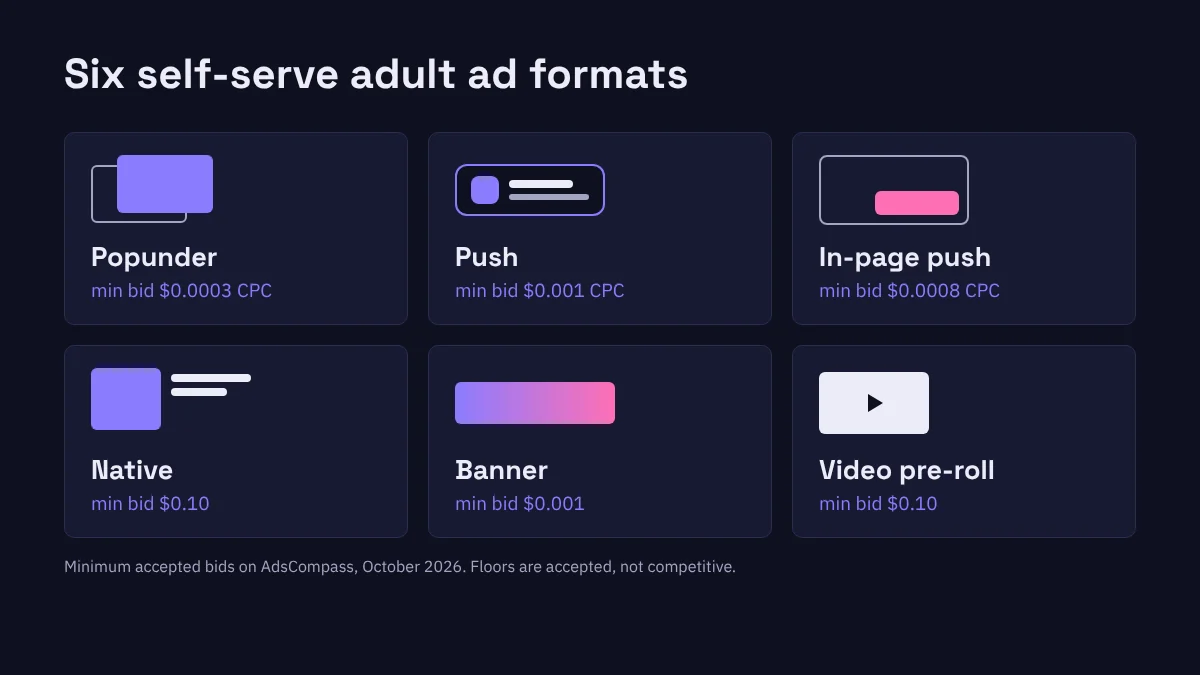
Six formats run self-serve on AdsCompass (adscompass.com): popunder, push, in-page push, native, banner and video pre-roll. Popunder, push and in-page push are bought on CPC. For native, banner and video pre-roll, confirm the billing unit in the dashboard when you build the campaign. The bids below are floors the system accepts, not bids that win.
| Format | Pricing model | Minimum bid on AdsCompass | Funnel it fits |
|---|---|---|---|
| Popunder | CPC | $0.0003 | 1-click, SOI, tube-to-tube |
| Push | CPC | $0.001 | Subscriptions, cams, recurring billing |
| In-page push | CPC | $0.0008 | iOS traffic, fresh sources |
| Native | Confirm at setup | $0.10 | Multi-step signups, paid membership |
| Banner | Confirm at setup | $0.001 | Branding, retargeting, member areas |
| Video pre-roll | Confirm at setup | $0.10 | Tube inventory, premium offers |
Auction pressure sets your real price above the floor. No per-GEO rate card exists, which is why the Traffic Calculator matters: it opens after free registration with no deposit, shows volume and average CPC by GEO and format with a mobile, desktop or combined filter, and its figures follow completed auctions.
Fifty dollars gets you in. All six formats open to buyers who buy adult traffic on AdsCompass with a $50 deposit, and direct publishers and RTB supply sit in the same auction, so one campaign reaches both. Together that supply runs to roughly 8 billion impressions and 60 million clicks daily.
Popunder for One-Step Flows
Popunder buys the cheapest cold volume on the network, and it fits flows where the payout fires one step after the click. The page opens behind or over the current one after a user clicks, so the visitor did not choose your offer. It was handed to them. That works for 1-click offers, SOI leads and tube-to-tube traffic, where the landing page itself is the conversion point.
Cold intent is the price you pay. A popunder visitor arrives mid-session and wants to get back to what they were doing. Ask for an email and some will type one. Ask for a card number three pages later and most are gone long before that. I would not send popunder to a paid membership page, and even with a pre-lander in front, native does that job better.
Low floors make popunder an easy first campaign. Pure arithmetic: $50 at the $0.0003 floor equals about 166,000 clicks, but floor bids sit at the back of the queue, and the auction decides what you actually pay.
Push and In-Page Push
Push buys subscribers, in-page push buys page visitors, even though the two look alike on screen. Both are CPC, both show a short title and a line of text with an image, and both reward creatives that read like a message rather than an ad.
Push reaches subscribed users
Push goes to people who already agreed to receive browser notifications from a site. That subscription is the whole value. You reach the same pool again and again, which fits subscriptions, cam offers and recurring billing, where a user often needs more than one touch before paying. The push floor sits at $0.001 CPC, the highest of the three CPC formats.
Frequency needs a cap here. Limit impressions per unique IP per day so a subscriber does not see the same creative until it turns into noise.
In-page push works without a subscription base, including iOS
No subscription needed: in-page push renders a push-style notification inside the publisher's page, so the user grants no browser permission. That makes it the push format for iOS traffic: on iPhone, web push only reaches sites saved to the home screen, so a classic subscriber base covers few iOS users. It also suits fresh sources that have not built a subscriber list yet. The floor is $0.0008 CPC.
Separate campaigns work best for these two. The audiences differ, so blended stats hide which one actually pays.
Native for Offers That Need a Landing Page
Native delivers a warm click, because the ad sits inside the content and the user chooses to click it. That choice matters when the funnel has several steps: registration, email confirmation, then a paid membership or card submit. Someone who clicked on purpose is more likely to reach step three than someone dropped there by a popunder.
Pre-landers belong with native. The creative makes a promise, the pre-lander explains it, and the offer page closes the sale. With a $0.10 minimum bid, judge native on cost per paid conversion rather than cost per click, because that is the number it was bought to move.
Banner and Video Pre-Roll
Supporting roles suit both formats. Neither is the main traffic engine for most buyers, but each does one job well.
Banners fit branding, retargeting slots, member areas and offers with a known brand name. Retargeting is where banners earn their place: collect visitors with the SST Pixel or the Audiences section, then show banners to people who landed but did not pay. The floor is $0.001.
Attention before content is what video pre-roll buys. The clip plays on tube inventory right before the user gets what they came for, which suits premium offers that need a few seconds of explanation. Put the offer in the opening seconds, because the viewer is waiting for something else. The floor is $0.10.
Telegram Rewarded Formats
Your AdsCompass manager launches both Telegram formats: Rewarded Post from $0.01 and Rewarded Video from $0.10. Neither is configured in the self-serve dashboard, because launch conditions are agreed with the manager rather than set in campaign settings. The traffic comes from verified Telegram mini-apps, where the user gets something back for engaging with the ad.
Reward motivation cuts both ways. It lifts clicks, but a user who clicked for a reward wanted the reward, not necessarily your offer. I would put these formats on SOI and other short flows first. Ask the manager up front which creatives and offers the placements accept before you build anything.
Matching the Format to Your Funnel
Count the steps between the click and the payout. That number picks the format faster than any CPC comparison. A popunder on a three-step subscription flow underperforms whatever the creative, because cold users drop at every step and three steps compound the loss.
- One step. 1-click, SOI and tube-to-tube: popunder first, in-page push second.
- Two steps. DOI or a short registration: push and in-page push, with native when the pre-lander needs room.
- Three or more steps. Paid membership, card submit, recurring billing: native and push to subscribed users, video pre-roll for premium offers.
- Already visited. Retargeting and brand recall: banner.
Split mixed funnels into separate campaigns. If one offer has a 1-click flow and a paid tier, send popunder to the 1-click landing and native to the membership page.